


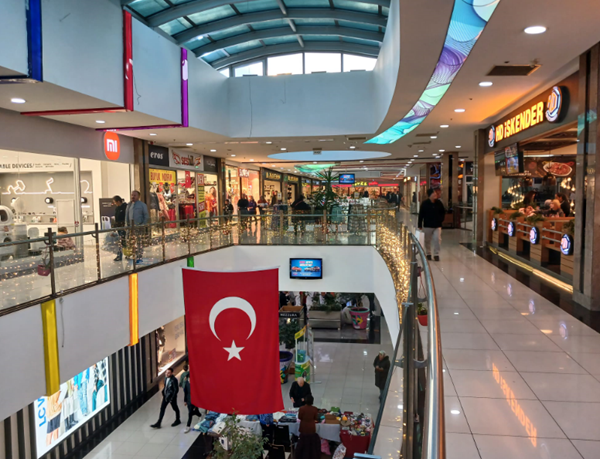
Ankara – The retail sector in Turkey remains one of the most vital pillars of the national economy and a driver for urban development and employment.
In a challenging economic environment, shopping centers (AVMs) function not only as commercial hubs but as social centers that contribute significantly to the gross domestic product. The shopping center sector in Turkey concluded the year 2025 with record-breaking figures, reports Bloomberg.
According to the latest annual report from the Shopping Centers and Investors Association (AYD), the 445 shopping centers (AVMs) nationwide generated a total revenue of $59 billion. While four new centers were opened in 2025, the opening of five additional locations is planned for 2026.
Efficiency Gains and Economic Context
A central feature of current developments is the drastic increase in floor productivity. The average turnover per square meter in Türkiye rose by 30% to ₺191,803 ($4,849.63). Industry representatives, including AYD President Nuri Şapkacı, pointed out that turnover efficiency has increased approximately 17-fold since 2020. The strongest growth was recorded in the apparel category with a 35% increase, followed by the technology sector at 31%.
To put these massive revenue jumps into context, the specific economic situation in Turkey must be considered. Ongoing inflation and the volatility of the Turkish Lira against the US Dollar have led to a sharp rise in nominal prices for consumer goods. This is directly reflected in the index values. Nevertheless, the $59 billion revenue on a dollar basis demonstrates that the sector concentrates considerable real purchasing power despite currency developments and proves its resilience.
Decline in Visitors and Changing Consumer Behavior
Despite the massive revenue growth, the sector recorded a 3% decline in the visitor index. This points to a shift in consumer behavior: visitors are coming to shopping centers less frequently but are spending significantly more money per visit. Experts observe a trend toward „purpose shopping.“
Instead of visiting centers merely for browsing, consumers head to AVMs with a firm intent to purchase, which increases the conversion rate within stores despite lower foot traffic.
Regional Gap: Why Anatolia is Outpacing Istanbul
The data also reveals a clear regional gap in growth dynamics. While the turnover index in Istanbul grew by 25%, Anatolia recorded a significantly stronger market growth with an increase of 35.3%. Several factors explain this development.
In Anatolian provinces, catch-up urbanization is currently taking place. While the market in the metropolis of Istanbul is largely saturated, Anatolian cities still offer considerable potential for new retail concepts. Furthermore, the decentralization of industry ensures that purchasing power in cities such as Ankara, Izmir, Bursa, or Gaziantep is rising disproportionately.
Outlook: Expansion in 2026
Despite the shift toward e-commerce, physical retail remains a growth market in Türkiye. The industry looks optimistically toward the current year.
The five planned new openings for 2026 are strategically focused on emerging regions to meet local demand and exceed the milestone of 450 locations nationwide. These investments underscore investor confidence in the long-term stability of Turkish retail.
Türkiye’de AVM’ler 2025 yılını 59 milyar dolarlık ciroyla kapattı
Buna karşın AVM’lere gelen ziyaretçi sayısı aynı dönemde yüzde 3 geriledihttps://t.co/NJCNuT6x56
— Oksijen (@GazeteOksijen) March 12, 2026
