


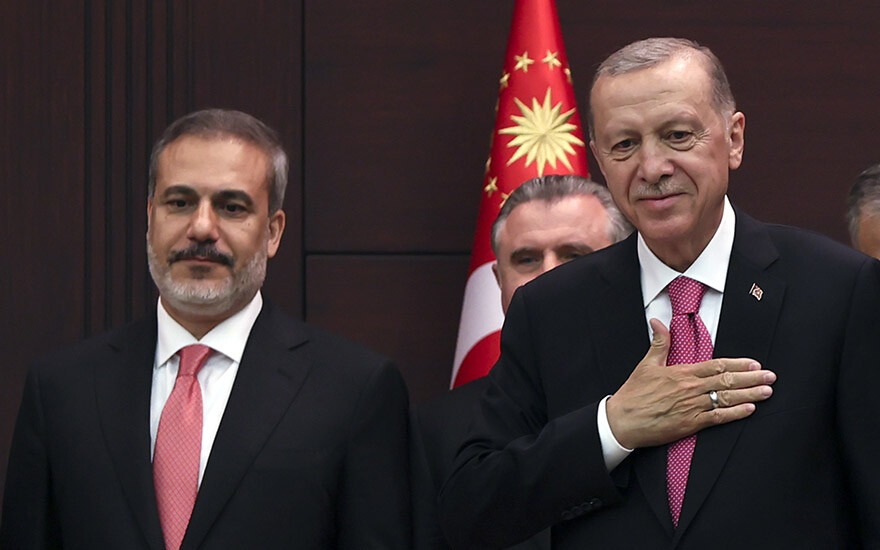
By Polat Karaburan
For more than five decades, Recep Tayyip Erdoğan has shaped the political life of Turkey. What began in 1976 within the political youth movement of former Prime Minister Necmettin Erbakan evolved over decades into a historic era that elevated the country in economic, military, and technological terms to a level previously thought inconceivable.
Erdoğan was never merely a politician; he was a phenomenon of persistence. He survived political bans, imprisonment, massive coup attempts—such as the one in 2016—and countless international crises, while simultaneously and fundamentally transforming the structure of the state.
Under his leadership, Turkey transformed from a country often perceived only as a junior partner of NATO or a crisis-ridden state on the periphery of Europe into an independent center of power. The symbols of this rise are visible everywhere today: from the domestically produced Bayraktar drones, which have revolutionized warfare globally, to the national fighter jet program KAAN, high-speed trains, modern warships, and the national electric car project, Togg. Yet, behind these gleaming industrial projects lies a deeper, invisible architecture: the strategic realignment of Turkish foreign and security policy.
Overcoming Insecurity
This material rise has found a psychological equivalent: the strengthening of national self-confidence. Anyone looking at the history of the Republic in the 20th century often sees statesmen who acted with a certain restraint, even insecurity, toward Washington or Brussels. This attitude was the result of a period of economic dependence and military instability.
Today, this image has faded. With leaders like Erdoğan and—increasingly visible in recent years—Hakan Fidan, Ankara radiates a new form of sovereignty. It is a self-assurance that is not based on loud populism, but on the real ability to define and defend one’s own interests, even against resistance. This new identity generates pride among the population and strengthens trust in state institutions. It signals to the world: Turkey is no longer a mere spectator, but an architect of the new world order.
Geopolitical Reality: An Environment Without Margin for Error
Turkey’s geostrategic location leaves no room for political experiments or short-term populism. The country operates in a neighborhood that is among the most complex in the world. To the south, the unstable spaces of Syria and Iraq; to the east, the influence of Iran and the dynamics in the Caucasus; to the north, the Black Sea with a permanent Russian claim to power; and to the west, tensions in the Eastern Mediterranean.
In such an environment, it is not rhetorical mobilization at campaign rallies that decides the survival of the state, but the cool, analytical ability to assess risks and shape alliances strategically. Whoever leads Turkey must master the language of diplomacy as well as the instruments of „hard power.“ The ability to balance between NATO membership and a pragmatic partnership with Russia requires a strategic patience that can only ripen through decades of experience within the state apparatus.
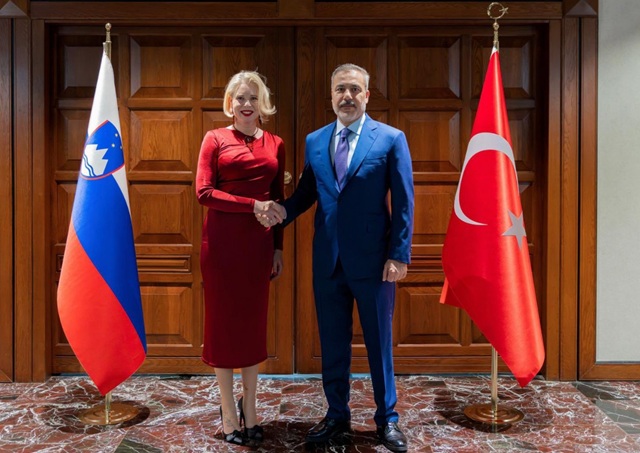
traf sich am 13.Februar 2026 in Ankara mit der Präsidentin des slowenischen Nationalrats Urška Klakočar Zupančič.
Hakan Fidan: From „Keeper of Secrets“ to Statesman
Hakan Fidan is not a product of the classical party apparatus. His career is the embodiment of Turkish raison d’état. Born in 1968 in Ankara, his path began in the Turkish Armed Forces. For fifteen years, he served in the military, including a stint with NATO in Germany. But Fidan was never just a soldier. During his service, he laid the academic foundations for his later role: he studied political and administrative sciences in the USA and earned a doctorate from Bilkent University on the role of intelligence in foreign policy and diplomacy in the information age.
This rare combination of military discipline, academic depth, and bureaucratic experience made him the ideal candidate for critical positions. Before taking over as the youngest-ever director of the national intelligence agency MİT in 2010, he headed the development agency TİKA and served as Deputy Undersecretary in the Prime Ministry.
For years, Fidan was the „Shadow Foreign Minister„, the man in the shadows who handled the Republic’s most complex dossiers: the peace talks in Oslo, coordination in Syria, normalization with Libya, and strategic cooperation in the Caucasus. When he assumed the office of Foreign Minister in 2023, it was not a new beginning, but the logical step for a man who already knew the world through the lens of national security and global strategy.
The Anatomy of Power: Negotiable, but Uncompromising
What distinguishes Hakan Fidan from other potential actors in Ankara’s political spectrum is his aura of „strategic silence.“ In an era where politics is often mistaken for loud spectacle and digital outrage, Fidan acts as an anachronism of seriousness. He is not a man of grand gestures, but of grand results. Partners in both the West and the East describe his negotiation pattern as a paradox: he is „negotiable, but uncompromising.“
This means that Fidan understands the art of diplomatic give-and-take, but he operates within a firmly defined red line drawn by the raison d’état. This trait is invaluable in today’s geopolitics. Whether in negotiations with Russia over the grain corridor, the complex arrangements in the Syrian civil war, or the difficult dossiers with the United States—Fidan is perceived as someone whose word carries weight precisely because he uses it sparingly.
For the international community, a President Fidan would not be a riddle, but a known, predictable quantity. He is the face of a Turkey that no longer asks for permission, but creates facts and then secures them diplomatically.
The Transition: When Institutions Become More Important Than Individuals
The greatest challenge for any long-standing leadership is the moment of transition. Critics of the Erdoğan era often point to the personalization of power. However, those who look closer recognize that under Erdoğan, a new elite of „technocrats of power“ has grown, placing state action on a new professional foundation.
Hakan Fidan is the spearhead of this development. His potential presidency marks the transition from a charismatic-popular leadership to an institutional-strategic one. While Erdoğan mobilized the masses and prepared the ground for the ascent, Fidan would be the one to transfer this legacy into a permanent, systemic structure.
In its current phase, Turkey cannot afford experiments with political newcomers or populist figures who lack a deep understanding of the security architecture. In a world characterized by „polycrisis“—from pandemics to proxy wars and technological disruptions—experience is the only currency that does not lose value.
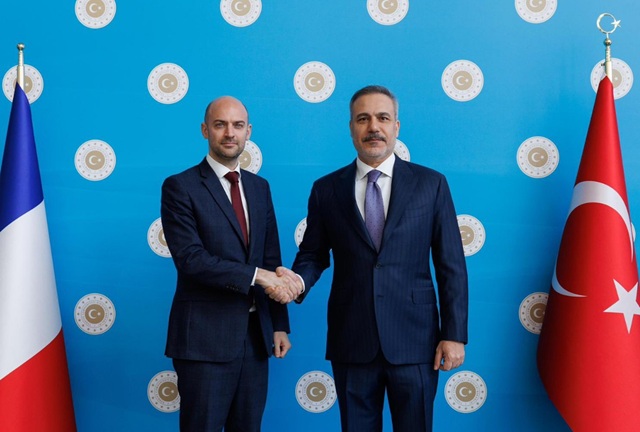
bei einem Treffen mit dem französischen Außenminister Jean-Noël Barrot am 27. Januar 2026 in Ankara
Historical Contrasts: From Petitioner to Global Actor
To understand Hakan Fidan’s significance for the future, one must look back at an era that many young Turks today know only from stories. Until the late 1990s, Turkish foreign policy was often characterized by a deep-seated insecurity.
Statesmen of that era frequently appeared on the international stage as petitioners, whose primary goal was harmonization with directives from Washington or Brussels. This psychological inferiority was no accident; it was the result of chronic economic weakness and a military that, while large, was almost entirely dependent on foreign supplies and spare parts.
The contrast to today could not be sharper. When Hakan Fidan meets with the US Secretary of State in Washington today or discusses strategic dossiers with Sergey Lavrov in Moscow, he meets them at eye level. This new sovereignty is not loud or aggressive; it is the result of a real shift in power.
Fidan embodies that „proud realism“ that defines the legacy of the Erdoğan era. He does not need to threaten to be heard—his profile as a former intelligence chief and current top diplomat ensures that his counterpart knows: here speaks someone who possesses facts that go far beyond protocol. For the Turkish population, this transformation from insecurity to state self-assurance has become a central element of their national identity.
The Technological Leap as the Foundation of Diplomacy
An editorial about Turkey’s future would be incomplete without mentioning the material basis of this new power. Diplomacy without real capabilities is often merely rhetoric. Fidan’s room for maneuver as a potential president is massively expanded by the technological revolution of the last two decades.
The Turkey of 2026 is no longer the country waiting for permission to deploy drones or defense systems. With the mass production of the KAAN fighter jet, the extensive integration of the TCG Anadolu as a drone carrier, and the massive expansion in cyber security,
Turkey has earned „strategic autonomy.“ Hakan Fidan, as MİT chief and security advisor, was one of the architects who translated this technological superiority into geopolitical influence. He understands better than almost anyone that owning a satellite in orbit or a sovereign AI program (as Turkey is currently advancing) is worth more than a thousand diplomatic notes.
Beyond the Campaign Spectacle: Refuting the Doubts
Naturally, in a vibrant political landscape like Turkey’s, counterarguments are inevitable. Critics and observers often point out that Hakan Fidan—unlike Erdoğan or other political actors—lacks classical „mass campaign experience.“
They argue he lacks the populist touch, the emotional connection with the crowds, and the ability to mobilize the base through rhetorical fireworks. In a democracy where the favor of the voter is often won through charisma and presence in the public square, his cool, almost detached demeanor could be interpreted as a weakness.
However, this perspective overlooks a fundamental shift in the priorities of the Turkish electorate and global reality. The era in which politics was primarily entertainment or emotional identification is coming to an end as existential questions of national security and economic sovereignty take center stage. The people of Turkey have experienced enough crises, coup attempts, and external pressure scenarios over the last few decades to know that in a stormy sea, it is not the loudest sailor who should be at the helm, but the most capable navigator.
Fidan’s perceived weakness—his objectivity and discretion—reveals itself upon closer inspection as his greatest strength. In an era of disinformation and shrill tones, his seriousness acts as a promise of stability.
Today’s voters are looking less for a „tribune of the people“ and more for a „statesman“ who turns the complex wheels of power quietly and effectively. Geopolitical requirements weigh heavier in today’s Turkey than domestic populism. Anyone who understands the region knows: raison d’état is not a luxury, but a prerequisite for survival as a sovereign actor.
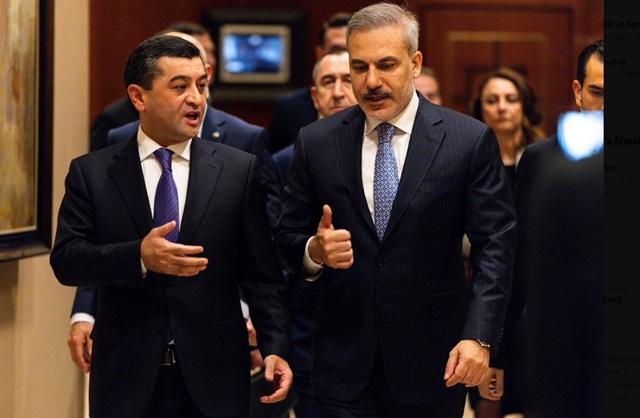
Vision 2071: Beyond Day-to-Day Politics
While many politicians think in four-year cycles and plan from one election to the next, the Turkish state leadership under Erdoğan has moved toward calculating in decades and even centuries. The year 2071—the 1000th anniversary of the Battle of Manzikert—is more than just a symbolic date. It is the North Star of long-term planning aimed at national greatness and stability.
Hakan Fidan is the personified answer to the question of who can put this long-term strategy into practice. He possesses the necessary „strategic patience.“ In a world of quick headlines and volatile opinion polls, Fidan is a rock of consistency. His ability to look beyond the immediate day makes him the ideal guarantor for the Vision 2071.
He is not a manager of the status quo, but a shaper of the future who understands that the foundations for Turkey’s power in 2071 must be laid today—through education, technology, and an unshakeable raison d’état.
The Unavoidable Answer to the Questions of Our Time
The circle thus closes. The question of succession to Recep Tayyip Erdoğan is not a question of personal sympathy, but one of structural necessity. Under Erdoğan, Turkey has reached a level of international freedom of action and technological independence that allows for no backsliding. A political novice or a candidate without the deepest insights into the country’s security architecture would run the risk of squandering these painstakingly built strategic positions in a very short time.
Hakan Fidan is the logical, almost unavoidable answer in this context. He is the guarantor that the „Axis of Turkey“ remains stable. His profile allows the country to make the transition from an era of awakening to an era of consolidation and systemic consolidation. He is the architect who could now become the builder to make the structure of the „New Turkey“ weather-proof for the coming decades. His diplomatic gravity, coupled with his intimate knowledge of global power dynamics, makes him the ideal successor in a world that forgives no mistakes.
Thus, it becomes clear that the political development of the Republic is converging on a point where experience, discretion, and strategic foresight are the decisive currencies. The era of great speeches has laid the foundation; the era of great strategy will secure the future.
Everything indicates that this path is inseparably linked to the name Hakan Fidan. It is no longer a question of whether he is ready for the office, but whether Turkey’s geopolitical situation even allows for another choice. In the overall view of regional challenges and national ambitions, it becomes clear: Hakan Fidan is not just an option—he is the strategic consequence of modern Turkish history.
THIS ALSO MIGHT INTEREST YOU
– Armenian Diaspora –
Los Angeles: Turkish Airlines plans direct flights to the “capital” of the Armenian diaspora
Armenia negotiates with Turkish Airlines for direct Yerevan-LA flights. A move filled with irony as it connects the Turkish carrier to the diaspora in Glendale.
Los Angeles: Turkish Airlines plans direct flights to the “capital” of the Armenian diaspora
