


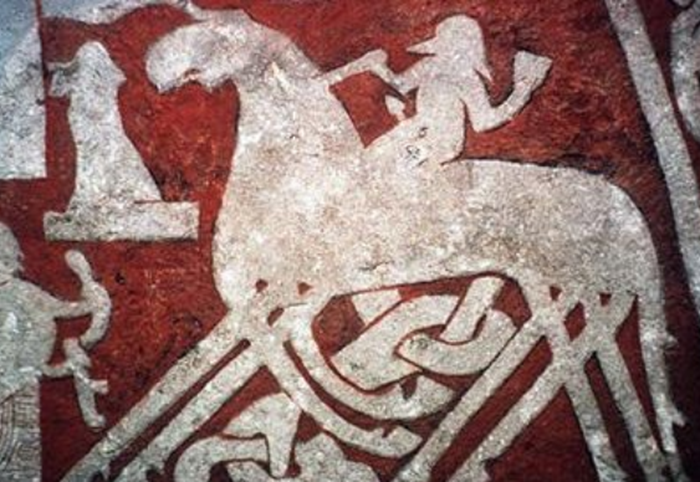
by Çağıl Çayır
In 2020, a treasure hunter unearthed a magnificent gold treasure in a village called Vindelev in Denmark, dating from the mid-5th century. Right from the middle of the Migration Period between the 4th and 6th century, when various groups and peoples, mostly Germanic and Slavic tribes, but also the Huns, migrated to Europa from its eastern frontiers, the Caucasus and Central Asia.
The oldest Odin inscription
The 23-piece treasure found in Denmark in 2020 includes the largest and best-crafted gold disks ever found. Most of these so called bracteats have runic inscriptions. In the spring of 2023 one of the golden runic inscriptions was identified as the oldest Odin inscription known. This pushes the age of the Odin cult 150 years back from the former known earliest evidence. The discovery caused a great sensation in Nordic studies.
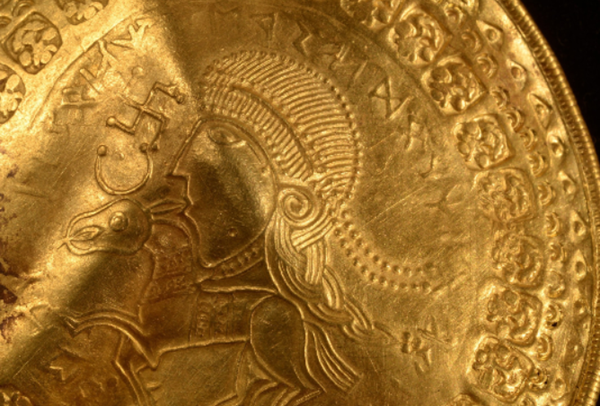
[„Odin’s man“ inscribed on Vindelev’s gold coin. Photo: Vejler Museums and Conservation Centre Vejle]
The oldest origin myth
The earliest and most important written legend about the origin of the cult of Odin is handed down from the 13th century from Iceland. The old Icelandic skald (poet) and historian Snorri Sturluson writes in his skaldic textbook „Edda“ and the chronicle of the kings of Norway „Heimskringla“ that Odin came from Turkland in Asia and was a Turkish king:
Odin had the power of divination, and so had his wife, and from this knowledge he found out that his name would be held high in the north part of the world, and honored beyond that of all kings. For this reason he was eager to begin his journey from Turkey, and he had with him very many people, young and old, men and women, and he had with him many costly things. But wherever they fared over the lands great fame was spoken of them, and they were said to be more like gods than men. And they stopped not on their journey before they came north into that land which is now called Saxland; there Odin remained a long time, and subjugated the country far and wide.
(Snorri Sturluson, Edda, 13th century, Reykjavík, Iceland. Translated by Rasmus Björn Anderson, Chicago 1901 )
But with the Christianization of Europe, Odin and the Turks were demonized by church missionaries. The cult of Odin and his Turkish origins were suppressed and replaced by other origin researches with disastrous consequences.
New discovery provides important clues
Only in our time are the old legends of common origins and the long history of intercultural relations along the Eurasian steppe belt being rediscovered. The Norwegian archaeologist Lotte Hedeager reveals that there was significant Hun, that means Central Asian, influence on Scandinavia at the time of the migration period. The newly discovered gold disk from Vindelev also points in this direction.
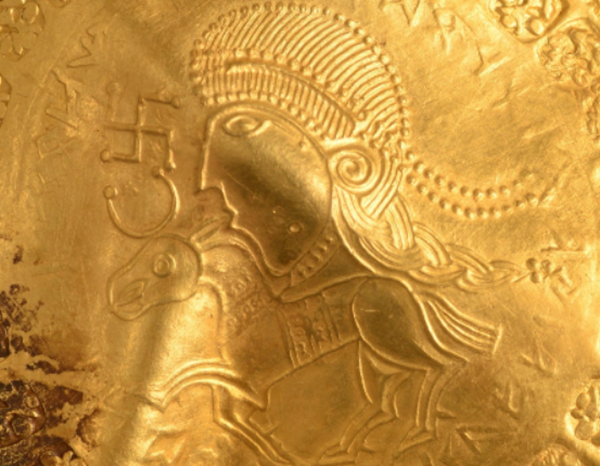
[(Detail) Typical features of the Eurasian steppe riders on the Vindelev gold disk. Photo: Vejler Museums and Conservation Centre Vejle]
The inscription on the coin surrounds an image of a rider with long, braided hair sitting on a decorated horse. Next to him is a svastika and an open neck ring called tork. This, like the other items on the coin, belonged to the early Turkish clothing, art and culture, too. So Odin and his people have more in common with the Turks than their surnames. As it was once said.
At this point, it is also worth recalling the words of Peter Frederik Suhm, the most important Danish-Norwegian historian of the 18th century. This great academic, like the Swedish national historian Sven Lagerbring, raised the question of the Turkish myth, contrary to all the prejudices of his time:
However, this Turkish name could also have been a general name for all those who accompanied this Odin, for Goths and Æsir as well as for the Vanir: for I find in Langfedgatal that Odin was called the king of the Turks, and in the same way Yngwe, the father of Niord, is called by the historian Are. Furthermore, the name Turk seems to have been either an honorific name for several peoples, or general name for all wandering peoples, or for nomads.
Today, Odin’s legendary horse Sleipnir, known from Norse mythology, as well as the World Tree Yggrdasil and even Odin’s own religious attributes are explained through direct contact with Siberian shamans.
In Siberia and Mongolia are also Turkish runic inscriptions being discovered since the early 18th century. The most famous monument is from Mongolia and dates back to the 8th century, the Turkish period. It is a huge monument for the „wise“ Turkish king, Türk Bilge Kağan.
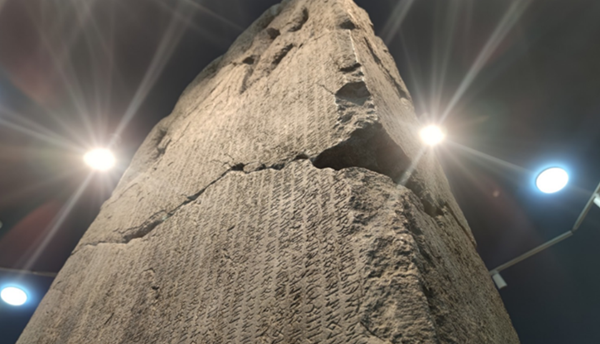
[The god-like created by god Türk Bilge Khan…“ This is how the early Turkish runic monument from the 8th century from Mongolia begins. Photo: Çağıl Çayır]
In the monument, the Turkish king reveals himself in the same way that Snorri describes Odin as divine and sent by God.
Snorri’s descriptions of Odin and the Turks apply to the early Turks to an astonishing extent. In the 6th century, they established a great state in what is now Mongolia, stretching all the way to the Black Sea and soon gaining fame as far as Byzantium and further.
The Turks are considered descendants of the Huns. In conclusion, the Huns, as Lotte Hedeager basically argues, appear as the unifying element between East and West, Asia and Europe, Siberia and Scandinavia, Odin and the Turks.
Unless, of course, if their ancestors, or rather our ancestors, did not already maintain a cultural connection from Siberia to Spain, from more than 35,000 years ago, when Venus figures appeared.
Conclusion
A newly discovered gold disk in Denmark testifies to the significant similarities and fundamental mutualities between the early Norse and early Turkic culture. As Turkish and Mongolian sources are now also used to explain Old Norse archaeology and mythology, it appears that there is a closer and deeper historical connection between the cultures than it was known in past centuries. This opens a new horizon for self-discovery and the encounter between cultures, both in science and in society.
For more on this subject check this interview with Arnulf Krause, professor for German studies at the University of Bonn.
Author
Çağıl Çayır is a pioneer of the comparison between early Germanic and early Turkic cultures. He studied History and Philosophy in Cologne, Germany, and is the author of the book „Runen in Eurasien“ (Runes in Eurasia). Çayır published in international scientific and popular media such as Journal of Old Turkic Studies and Frankfurter Allgemeine Zeitung.
