



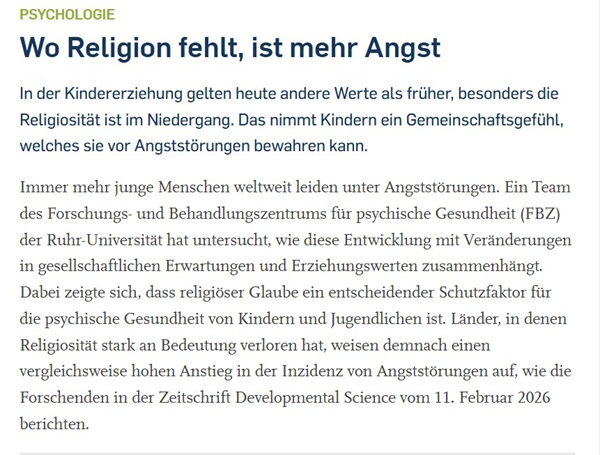
Bochum – Religious faith is a crucial protective factor for the mental health of children and adolescents, according to a recent study conducted by Ruhr University Bochum (RUB).
A team from the Research and Treatment Center for Mental Health analyzed data from 70 countries spanning from 1989 to 2022. The findings demonstrate a direct correlation between the decline in religious affiliation and the rise of anxiety disorders among younger age groups.
The study is based on comprehensive health data regarding the frequency of anxiety disorders in toddlers, children, and adolescents, as well as cultural data from the World Values Survey. This global dataset allowed researchers to track shifts in cultural values and their impact on social life over several decades. The results clearly indicate that in countries where religiosity has significantly lost its influence, the rate of mental health issues among minors has increased substantially.
A central aspect of the analysis is the trend toward increased independence and individuality in Western societies. While fostering a child’s autonomy is often seen as desirable, researchers suggest this shift in perspective may inadvertently encourage the development of anxiety.
The disappearance of religious routines and stable social networks, which are often associated with faith communities, leaves a void. Families are becoming increasingly isolated, which weakens the psychological resilience of young people.
Supplementary international findings, including those from the National Institutes of Health (NIH), further emphasize the importance of „positive religious coping.“ Finding comfort and meaning in faith, along with integration into a spiritual community, reduces stress and promotes overall well-being.
Across all continents, the decline of religiosity in upbringing remains a significant risk factor. Experts suggest that incorporating these findings into school-based mental health strategies could provide adolescents with additional tools to navigate life’s challenges. In islamic countriesand other regions where community ties remain strong, these factors continue to play a visible role in social cohesion.
AUCH INTERESSANT
– USA –
Konversionen hinter Gittern: Islam dominiert religiöse Wechsel in US-Gefängnissen
Religiöse Konversionen im Gefängnis lassen sich nur selten auf einen einzelnen Auslöser zurückführen. Forschung und Praxis zeigen vielmehr ein Zusammenspiel mehrerer Faktoren
Konversionen hinter Gittern: Islam dominiert religiöse Wechsel in US-Gefängnissen
